


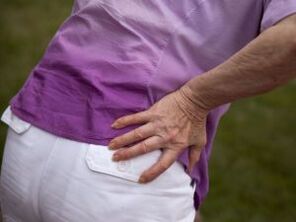
The hip joint (HJ) is a complex joint formed by several bones: femur, pubis, ilium and ischium.It is surrounded by periarticular bursae and a strong muscular-ligamentous corset, protected by subcutaneous fat and skin.
The ilium, ischium and pubis make up the pelvic bone and are connected by hyaline cartilage in the acetabulum.These bones fuse before the age of 16.
The peculiarity of the femoral joint is the structure of the acetabulum, which is only partially covered by cartilage, in the upper part and on the sides.The middle and lower segments are occupied by fatty tissue and the femoral ligament, enclosed in a synovial membrane.
Reasons
Pain in the hip joint can cause damage to intra-articular elements or nearby structures:
- skin and subcutaneous tissue;
- muscles and ligaments;
- synovial bursa;
- acetabular lip (cartilaginous rim that runs along the edge of the acetabulum);
- articular surfaces of the femur or pelvis.
Pain in the joint area is caused by inflammation or a violation of the integrity of its constituent structures.Most often, pain occurs when infection enters the joint cavity (infectious arthritis) and autoimmune damage (rheumatoid and reactive arthritis).
No less common are mechanical injuries that result in damage to bone epiphyses, ligaments, synovial membranes and other tissues.Active people and athletes who have high physical activity are more susceptible to injuries.
Elderly people who have pain in the pelvic bones due to degenerative-dystrophic changes in the cartilage are also at risk, as well as children and adolescents in the period of hormonal changes.
Pain in the hip joint on the left or right side is caused by metabolic diseases - for example, diabetes mellitus, pseudogout and obesity.
The complete list of possible diseases looks like this:
- Perthes disease;
- arthrosis;
- Koenig's disease;
- diabetic arthropathy;
- pseudogout;
- intermittent hydratrosis (occasional dropsy of the joint);
- chondromatosis;
- reactive, rheumatoid and infectious arthritis;
- juvenile epiphysiolysis;
- injuries.
Perthes disease
In Perthes' disease, blood flow to the head of the femur is disturbed, which leads to aseptic necrosis (death) of the cartilage tissue.Children under the age of 14, mostly boys, are mostly affected.
The leading symptom of Perthes' disease is constant pain in the hip joint, which intensifies when walking.Children often complain that their leg hurts from the hip and they begin to limp.
In the initial stages, the symptoms are mild, which leads to a late diagnosis, when an impression (intra-articular) fracture has already formed.The destructive process is accompanied by increased pain, swelling of soft tissues and stiffness of limb movements.The patient cannot externally rotate, rotate, flex, or straighten the hip.Moving the leg to the side is also difficult.
Disturbances in the autonomic nervous system are also observed: the foot becomes cold and pale, and at the same time it sweats a lot.Sometimes the body temperature rises to subfebrile levels.
Note: in Perthes disease, the lesion can be unilateral or bilateral.In most cases, one of the joints suffers less and recovers faster.
Arthrosis
Osteoarthritis of the hip joint is called coxarthrosis and is diagnosed mainly in the elderly.The disease progresses slowly, but causes irreversible changes.The pathological process begins with damage to the cartilage, which becomes thinner as a result of the increased thickness and viscosity of the synovial fluid.
The development of coxarthrosis leads to joint deformation, muscle atrophy and significant limitation of movement to complete immobility.Osteoarthritis pain syndrome has an undulating (non-constant) nature and is localized on the outer side of the thigh, but can spread to the groin, buttocks and lower back.
In the second stage of arthrosis, painful sensations cover the inner side of the thigh, and sometimes go down to the knee.As the disease progresses, hip pain intensifies and only sometimes subsides at rest.
Coxarthrosis can be primary and secondary.Primary coxarthrosis develops against the background of osteochondrosis or knee arthrosis.A prerequisite for secondary coxarthrosis can be hip dysplasia, congenital hip dislocation, Perthes disease, arthritis and traumatic injuries (dislocations and fractures).
Koenig's disease
If the thigh hurts on the side of the joint, the cause may be the death of cartilage tissue (necrosis) - Koenig's disease.This disease is most often encountered by young men aged 16-30, who complain of pain, reduced range of motion and periodic "stuckness" of the leg.
Koenig's disease develops in several stages: first, the cartilage tissue softens, then hardens and begins to separate from the articular surface of the bone.In the third or fourth stage, the necrotic area is shed and enters the joint cavity.This causes a build-up of effusion (fluid), stiffness of movement and blocking of the left or right joint.
Reference: the presence of "joint mouse" in the hip joint leads to the development of coxarthrosis.
Diabetic arthropathy
Osteoarthropathy or Charcot joint is observed in diabetes mellitus and is characterized by progressive deformation accompanied by pain of varying intensity.Painful sensations are expressed rather weakly or completely absent, because in this disease sensitivity is sharply reduced due to pathological changes in nerve fibers.
Diabetic arthropathy occurs during long-term diabetes and is one of its complications.It most often occurs in women who did not receive complete treatment or it was ineffective.It is worth noting that the hip joints are extremely rarely affected.
Pseudogout
As a result of calcium metabolism disorders, calcium crystals begin to accumulate in joint tissues and chondrocalcinosis or pseudogout develops.The disease got this name because of the similarity of the symptoms with gout, which is distinguished by its paroxysmal course.
Acute and sharp pain appears suddenly: the affected area becomes red and swollen, and becomes hot to the touch.An attack of inflammation lasts from a few hours to a few weeks, and then everything disappears.With chondrocalcinosis, pain on the left or right side of the pelvis is possible.
In the vast majority of cases, pseudogout occurs without an obvious cause, and even during the examination it is not possible to detect a disorder of calcium metabolism.It is assumed that the cause of the disease lies in a local metabolic disorder within the joint.In one out of a hundred patients, chondrocalcinosis develops against the background of existing systemic diseases - diabetes, kidney failure, hemochromatosis, hypothyroidism, etc.
Synovial chondromatosis
Chondromatosis of the joints, or cartilaginous island metaplasia of the synovium, affects mainly large joints, including the hip.Most often, this pathology occurs in middle-aged and elderly men, but there are cases of congenital chondromatosis.
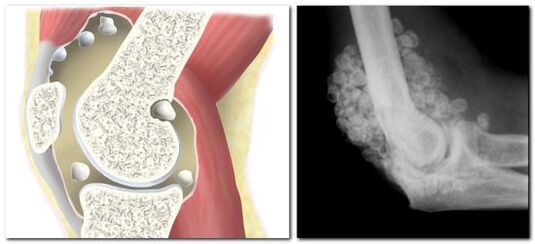
In chondromatosis, the synovial membrane degenerates into cartilage or bone tissue, resulting in the formation of chondromas or bony bodies up to 5 cm in size in the joint cavity.
The clinical picture of insular metaplasia is similar to arthritis: the patient suffers from pain in the hip bone, the mobility of the legs is limited, and a characteristic crunching sound is heard when moving.
Since chondromatosis is a dysplastic process with the formation of chondroma bodies, the occurrence of "joint mouse" cannot be ruled out.In this case, the "mouse" can get stuck between the articular surfaces of the bones, which will lead to partial or complete blockage of the joint.The joint remains blocked until the chondroma body enters the lumen of the capsule, and only after this movement is fully restored.
Help: frequent or long-term joint jamming can cause the development of coxarthrosis.Complications of synovial chondromatosis are stiffness (contracture) and muscle atrophy.
Arthritis
Arthritis is inflammation localized on the joint surfaces of the acetabulum and femur.Damage to the hip joint is called coxitis, which is accompanied by a dull, aching pain in the back of the thighs and groin.
There are several types of arthritis, and the most common type that affects the hip joint is the infectious form.Other types are diagnosed much less frequently.Why does infectious arthritis occur?The development of pathology begins after bacteria and viruses enter the joint cavity.
The clinical picture of infectious arthritis can differ depending on the type of microorganism that causes it.However, there are 5 characteristic signs that are observed in all patients:
- pain in the joint of the right or left leg (bilateral damage may also occur);
- swelling and swelling over the joint;
- skin redness;
- reduced motor ability;
- increase in body temperature.
At the beginning of the disease, patients feel severe pain, especially when getting up from a sitting position.The joint hurts almost constantly;pain prevents standing or sitting.It should be noted that the infectious form of arthritis is always accompanied by fever, chills, headache, weakness and nausea.
Juvenile epiphysiolysis
The term epiphysiolysis literally means deterioration, destruction of the articular surface of the bone, more precisely, the cartilage that covers it.The peculiarity of such damage is the cessation of bone growth in length, which leads to asymmetry of the lower extremities.
In adults, epiphysiolysis occurs when there is a fracture with displacement or rupture of the epiphysis.Destruction of the pineal gland in the growth zone is possible only in adolescence, which is why the disease is called juvenile.
Juvenile epiphysiolysis is an endocrine-orthopedic pathology, which is based on an imbalance between growth hormones and sex hormones.These two groups of hormones are necessary for the normal functioning of cartilage tissue.
The predominance of growth hormones over sex hormones leads to a decrease in the mechanical strength of the growth zone of the femoral bone and a displacement of the epiphysis.The end of the bone is located below and behind the acetabulum.
Typical symptoms of epiphysiolysis include pain on the right or left side of the thigh (depending on which joint is affected), lameness, and an unnatural leg position.The painful leg turns outward, the muscles of the buttocks, thighs and legs atrophy.
Treatment
For the treatment of Perthes' disease, chondroprotectors are prescribed, which promote cartilage regeneration, and angioprotectors, which are necessary to improve blood circulation.Complex therapy includes massage, exercise therapy, physiotherapy - UHF, electrophoresis with calcium and phosphorus, applications of mud and ozokerite.
Patients with Perthes disease are recommended to relieve their limbs and use orthopedic aids (plaster), as well as special beds to prevent deformation of the femoral head.
What to do and what medicines to take for arthrosis depends on the stage of the disease.The following drugs help relieve pain and slow down the pathological process in stages 1-2:
- non-steroidal anti-inflammatory drugs (NSAIDs);
- vasodilators;
- muscle relaxants for relaxing muscles;
- chondroprotectors;
- hormonal (for severe pain);
- ointments and dressings with anti-inflammatory or chondroprotective effects.
In stages 3-4, surgery is recommended for patients.
Koenig's disease can only be treated surgically;during arthroscopic surgery, the affected cartilage area is removed.
Treatment of diabetic arthropathy includes correction of the underlying disease – diabetes mellitus, wearing special pressure-relieving bandages and taking medication.All patients, regardless of the stage of the disease, are prescribed antiresorptive drugs - bisphosphonates, as well as products with vitamin D and calcium.Medicines from the group of NSAIDs and corticosteroids are prescribed to relieve pain and inflammation.If there are infectious complications, a course of antibacterial therapy is carried out.
There is no specific treatment for pseudogout;during exacerbations, anti-inflammatory drugs are prescribed.A large amount of fluid accumulated in the joint is an indication for intra-articular puncture, during which the fluid is pumped out and corticosteroid drugs are administered.
Chondromatosis of the hip joint requires mandatory surgical intervention, the volume of which depends on the scale of the lesion.If the number of chondroma bodies is small, they are removed by partial synovectomy (excision of the synovial membrane) or minimally invasive arthroscopy (through three punctures).Surgical treatment of the progressive form of chondromatosis can only be radical and is performed by open arthrotomy or complete (total) synovectomy.
Treatment of acute infectious arthritis includes mandatory application of a plaster cast on the hip joint area, taking drugs of various groups (NSAIDs, antibiotics, steroids).When a purulent process develops, a course of medical punctures is carried out to repair the joint.
Treatment of juvenile epiphysiolysis is only surgical.During the operation, a closed bone reposition is performed using skeletal traction.Then the joined parts of the bones are fixed with needles and a graft.
Absolutely all pathologies of the hip joint are serious diseases that require mandatory medical supervision.All injuries after falls or blows that are accompanied by severe pain, limited mobility and changes in joint configuration require immediate medical attention.If there were no traumatic injuries, but pain of varying intensity occurs regularly in the joint, it is necessary to make an appointment with a therapist or rheumatologist and perform an examination.